Table of Contents
▼
Can a non-resident get an EIN without an SSN or ITIN?
Yes. The IRS issues EINs to foreign persons and foreign-owned entities, and the entity itself does not need an SSN or ITIN. The EIN application process for non-US residents runs through paper Form SS-4, not the online tool, and the responsible party block is where most applications live or die.
Quick Answer: A non-US resident can get an EIN without an SSN or ITIN by filing Form SS-4 by fax or mail. You enter the individual owner or officer as the responsible party on Line 7a and check the box showing the number has been applied for, or enter "Foreign" per the IRS instructions. The IRS charges nothing for the EIN.
An EIN is a nine-digit number, formatted XX-XXXXXXX, that the IRS assigns to a business for tax filing and reporting. Think of it as a Social Security Number for your company. It is not yours. It belongs to the entity. [1]
Keep the acronyms straight before you file:
- SSN: the individual's US Social Security number. You almost certainly do not have one.
- ITIN: a tax processing number the IRS issues to individuals who need to file US returns but cannot get an SSN. It is personal, not corporate.
- TIN: the umbrella term. An EIN, SSN and ITIN are all TINs.
- EIN: the business's number. This is the one you are applying for.
You need an EIN to open a US business bank account, file federal tax returns, run payroll, and register with payment processors. [1] Without one, most US banking and payments infrastructure simply stops at the front desk.
The order of operations matters. Form the entity at the state level first (Wyoming and Delaware are the two most common choices for Indian founders), then apply for the EIN in that entity's name. The IRS issues the number to a registered business, not to an idea. [6]
If you have not formed the company yet, start with US LLC formation for non-residents and come back here once your Articles of Organization are stamped.
Which Form SS-4 lines actually decide approval for a non-resident?
The lines that decide approval are 1, 7a, 7b, 8a, 9 and 18. Get those six right and the rest of Form SS-4 is clerical. Get Line 7b wrong and you will wait weeks for an IRS letter asking you to explain yourself.
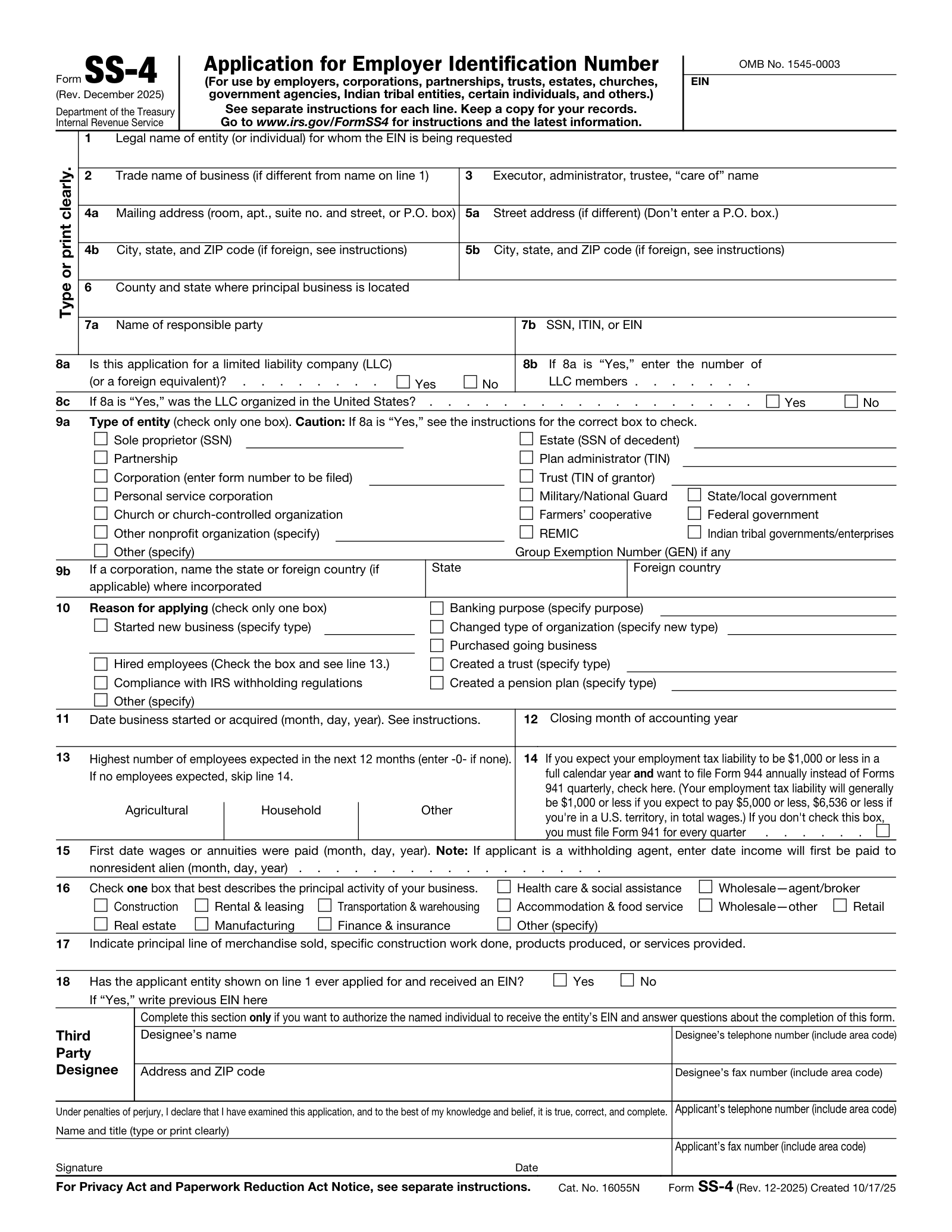
Official form (IRS.gov): Form SS-4 official PDF
Here is the line-by-line for a foreign-owned LLC, which is the case for nearly every reader of this article:
- Line 1, legal name: exactly as it appears on your state filing. "Nexa Trading LLC," not "Nexa." A mismatch with state records is the single most common reason the IRS bounces an application back.
- Line 2, trade name: your brand if it differs. Otherwise leave blank.
- Line 3a, executor/trustee: N/A. This line is for estates.
- Line 4a/4b, principal activity: be plain. "E-commerce," "software consulting," "digital marketing." Do not write "holding company" unless that is genuinely what it is, because it invites questions.
- Line 5a, started new business: check it.
- Line 7a, responsible party: the human being with ultimate control. That is you, the member or manager. Not the registered agent. Not the formation company. You.
- Line 7b, SSN/ITIN/EIN: the pain point. Covered in the next section.
- Line 8a, entity type: check "Limited liability company" and enter the number of members on 8b. A single-member LLC writes 1.
- Line 9, who is applying: check "Other" and write "Foreign-owned U.S. LLC" or "Foreign corporation" as appropriate.
- Line 10, reason for applying: "Started new business" or "Banking purpose." Both are accepted.
- Line 11, date business started: the date your state accepted the formation filing.
- Line 18, third-party designee: leave it blank unless you are authorizing a specific person in the US to speak to the IRS on your behalf.
Say your Wyoming LLC was formed on 3 March 2026 and you write "March 2026" on Line 11. The IRS wants a date, not a month. Write 03/03/2026. Small thing, real delay.
Line 18 deserves a note. Checking "Yes" authorizes a named designee to receive the IRS's calls and correspondence about this application. If your registered agent or a US-based accountant will handle IRS contact, this is useful. If not, leave it blank. A blank Line 18 has never delayed an EIN.
What do you write in the responsible party section when you have no SSN or ITIN?
Write your own legal name on Line 7a, exactly as it appears on your passport. On Line 7b, check the box indicating the number has been applied for, or enter "Foreign" where the IRS instructions allow it for a responsible party living abroad. Never leave 7b blank.
The responsible party is the individual who controls the entity: the sole member of a single-member LLC, a managing member of a multi-member LLC, or an officer of a corporation. The IRS wants a person, not a company. [3]
Three scenarios, three answers:
Single-member LLC, Indian founder. Line 7a: your full legal name. Line 7b: check "applied for" if you have an ITIN application pending, or enter "Foreign" per the instructions. This is the standard path and the IRS accepts it.
Multi-member LLC. One responsible party only. Pick the member with the largest stake or the managing member. Listing two people on 7a creates a mismatch the IRS has to resolve by letter.
C-Corp with a non-resident director. The responsible party is typically the president or principal officer, even if that person lives in Bengaluru. Same rule applies on 7b.
Now the mistake that costs the most time: writing the registered agent's name or the formation company's name on Line 7a. Founders do this because the agent has a US address and it feels cleaner. It is not. The IRS expects the individual owner or officer, and an agent listed as responsible party triggers a request for more information. [4]
Heads-up: the IRS can and does send a letter asking you to clarify the responsible party. Respond within the deadline on the letter with a signed statement naming the correct individual. Ignoring it means no EIN.
If you plan to file US personal returns later, an ITIN is a separate application on Form W-7. See how to apply for an ITIN for that track.
Should you apply online, by fax, or by mail, and how long does each take?
Non-residents cannot use the IRS online EIN assistant. It requires a valid SSN, ITIN or EIN for the responsible party, and a founder in Mumbai has none of those. Fax is the fastest route. Mail works. Phone is for international applicants in specific cases only. [3][5]
| Method | Who can use it | Typical turnaround | Government cost | Notes |
|---|---|---|---|---|
| Online assistant | Responsible party with a valid SSN/ITIN/EIN | Same session | Free | Blocked for most non-residents |
| Fax (Form SS-4) | Anyone | About 4 business days for the IRS fax-back | Free | Keep the fax confirmation page |
| Mail (Form SS-4) | Anyone | Several weeks | Free | Send tracked courier, not ordinary post |
| Phone | International applicants, per IRS instructions | Varies | Free | Confirm eligibility before calling |
Cost is not the differentiator. The IRS charges nothing for an EIN. Every dollar you see quoted for "EIN service" is a third-party agent fee or courier cost, and it is optional. [3]
Fax mechanics, in order: complete the SS-4, sign it, fax it to the IRS number listed in the SS-4 instructions for your state of formation, and keep the confirmation page. The IRS faxes the EIN back, usually within about four business days..
Suppose you fax on a Friday afternoon from India. The IRS receives it Monday morning US time. Your four business days start Monday, not Friday. Budget a week and you will not be disappointed.
Mail works fine if you are not in a hurry. Send it tracked. A lost SS-4 in international post means starting over, and the IRS has no record to check against.
Do not pay an agent to "expedite" an EIN. There is no expedite lane. The IRS processes in the order received.
What happens after the EIN is issued, and what can you do with it?
You receive a CP 575 notice, the IRS letter that states your EIN and the entity name. That letter is your proof of the number. Use the EIN to open a US business bank account, register with payment processors, and file federal returns. It is not a bank account, a credit score, or a substitute for an ITIN.
Lost the CP 575? Request a Letter 147C, the IRS's replacement confirmation. Call the IRS Business & Specialty Tax Line and ask. Banks accept a 147C in place of the original notice..
Now the obligation most founders miss. A foreign-owned single-member LLC generally files Form 5472 with a pro forma Form 1120 each year, and failure to file carries a penalty.. This is an annual filing, not a one-time form. Put it in your calendar the day you get the EIN.
Banking is its own project. Plenty of US banks still ask non-resident owners for an ITIN or an in-person visit. Fintechs are more flexible but make their own approval decisions. An EIN makes you eligible to apply. It does not guarantee approval, and no provider promises that. If you want the online route, see opening a US business bank account.
Imagine you get the EIN on a Tuesday and apply to a payment processor the same week. They ask for a W-8BEN-E and a bank account. The EIN was step one of five. Sequence it: entity, EIN, bank account, payments, tax filings.
Why is your EIN application delayed or rejected, and how do you fix it?
Most delays come from a blank or inconsistent responsible party line, an entity name that does not match state records, a missing signature, or a fax sent to the wrong IRS campus. Each has a direct fix.
| Symptom | Likely cause | Fix |
|---|---|---|
| No fax-back after a week | Wrong campus fax number, or fax not received | Confirm the number in the SS-4 instructions for your state, refax, keep the confirmation |
| IRS letter asking for more information | Responsible party unclear or missing | Reply by the deadline with a signed statement naming the individual |
| Application rejected on name | Line 1 differs from state filing | Refax with the exact legal name |
| Long silence after mailing | Ordinary post delay | Call the IRS Business & Specialty Tax Line with your copy of the SS-4 |
To check status, call the IRS Business & Specialty Tax Line. Have your fax confirmation and a copy of the SS-4 in front of you. International applicants can call this line..
Do not refax the same SS-4 three times in a week. Duplicate submissions create duplicate records and slow everything down. One fax, one confirmation, one week of patience, then call.
Common Mistakes
- Listing the registered agent or formation company as responsible party. The IRS expects the individual owner or officer. This is the top rejection trigger. [4]
- Leaving Line 7b blank. Check "applied for" or enter "Foreign." A blank line reads as an incomplete application.
- Using the online assistant without an SSN or ITIN. The tool requires a valid number for the responsible party. It will not work for you. [3]
- Faxing to the wrong campus. The fax number depends on your state of formation. Pull it from the SS-4 instructions, not from a blog post.
- Assuming the EIN replaces an ITIN. They are different numbers for different purposes. An EIN does not let you file a personal US return.
- Forgetting the annual 5472/1120 filing. This is a recurring obligation with a penalty attached, not a one-time step.
- Applying before the entity exists. The IRS issues the EIN to a registered business. Form the LLC first. [6]
My blunt calls: fax, do not mail, unless you genuinely have six weeks to spare. Enter your own name on Line 7a even though the agent's US address looks tidier. And skip paid EIN "expedite" services, because there is no expedite lane to buy.
If the tax side is where you want help rather than the form, federal tax support for Form 5472 and Form 1120 covers the annual filings. For the EIN itself, EIN assistance for non-US residents walks the SS-4 with you.
Frequently Asked Questions
Can I get an EIN without an SSN or ITIN? Yes. The entity gets the EIN. The responsible party's SSN or ITIN is not strictly required if you check "applied for" or enter "Foreign" per the IRS instructions.
What exactly do I write on Line 7b of Form SS-4? Your SSN, ITIN or EIN if you have one. Otherwise check the "applied for" box or write "Foreign" as the instructions allow. Never leave it blank.
Can non-residents use the IRS online EIN assistant? No, in practice. The tool requires a valid SSN, ITIN or EIN for the responsible party. Non-residents fax or mail Form SS-4.
How long does an EIN take by fax versus mail? Fax is faster, with the IRS faxing back in about four business days. Mail takes several weeks. Confirm current IRS processing times before you plan around them.
Does the IRS charge a fee for an EIN? No. The EIN is free. Any charge comes from a third-party agent or courier.
What filings does a foreign-owned LLC need after getting an EIN? A foreign-owned single-member LLC generally files Form 5472 with a pro forma Form 1120. Other entity types file Form 1120 or 1120-S. Confirm your situation with a qualified tax professional.
NexFyla helps non-US founders form US companies and set up EIN and US business banking support. If you want help with US LLC formation, EIN and business setup, NexFyla can assist.
*Last updated: February 2026.*
Related reading
- How to Get an EIN for a Non-US Resident in 2026 Without an SSN
- EIN for a Non-Resident LLC in 2026: Do You Need an ITIN First?
- IRS ITIN Application Requirements in 2026: What Non-Residents Must Submit
Ready to act on this? EIN assistance takes the filing, registered agent and paperwork off your desk.