Table of Contents
▼
Should you apply for an EIN before or after your LLC is formed?
Form the LLC first. Then apply for the EIN. Form SS-4 asks for your entity's formation state and date, and the IRS expects the entity to legally exist when you apply [1].
Quick Answer: For a non-US resident, the sequence is: state approves your LLC, then you file Form SS-4 for an EIN. The EIN is free from the IRS and takes one of three routes without an SSN: fax, mail, or phone for international applicants. Apply too early and the name on your SS-4 will not match the state record, which triggers IRS follow-up and delays bank onboarding.
That sequencing question is where most guides go quiet. They list the application channels, then move to banking. The order matters more than the channel.
Say your Wyoming LLC is approved on 3 March with the legal name "Kestrel Labs LLC." Your SS-4 line 1 must read exactly that, including the suffix. Write "Kestrel Labs" and the IRS may come back to you, and your bank will flag the mismatch when it compares the EIN letter to your Articles of Organization.
What "formation date" actually means
It is the state's effective date, not the day you clicked submit on the formation portal. Wyoming, Delaware and most other states stamp an effective date on the filed Articles of Organization (the document that creates your LLC). Use that date on SS-4 line 8a.
A foreign entity that is not forming a US LLC can still apply for an EIN with a foreign address. The same logic holds: legal existence first, tax ID second.
If you have not formed the entity yet, start with US LLC formation for non-residents and come back to this page once the state has approved the filing.
Which EIN application method can a non-resident actually use?
Fax, mail, or phone. The online application is effectively closed to you unless you already hold a valid SSN, ITIN or EIN, because the portal's identity step requires one [1]. The IRS confirms international applicants may apply by phone, and fax and mail remain open to everyone [4].
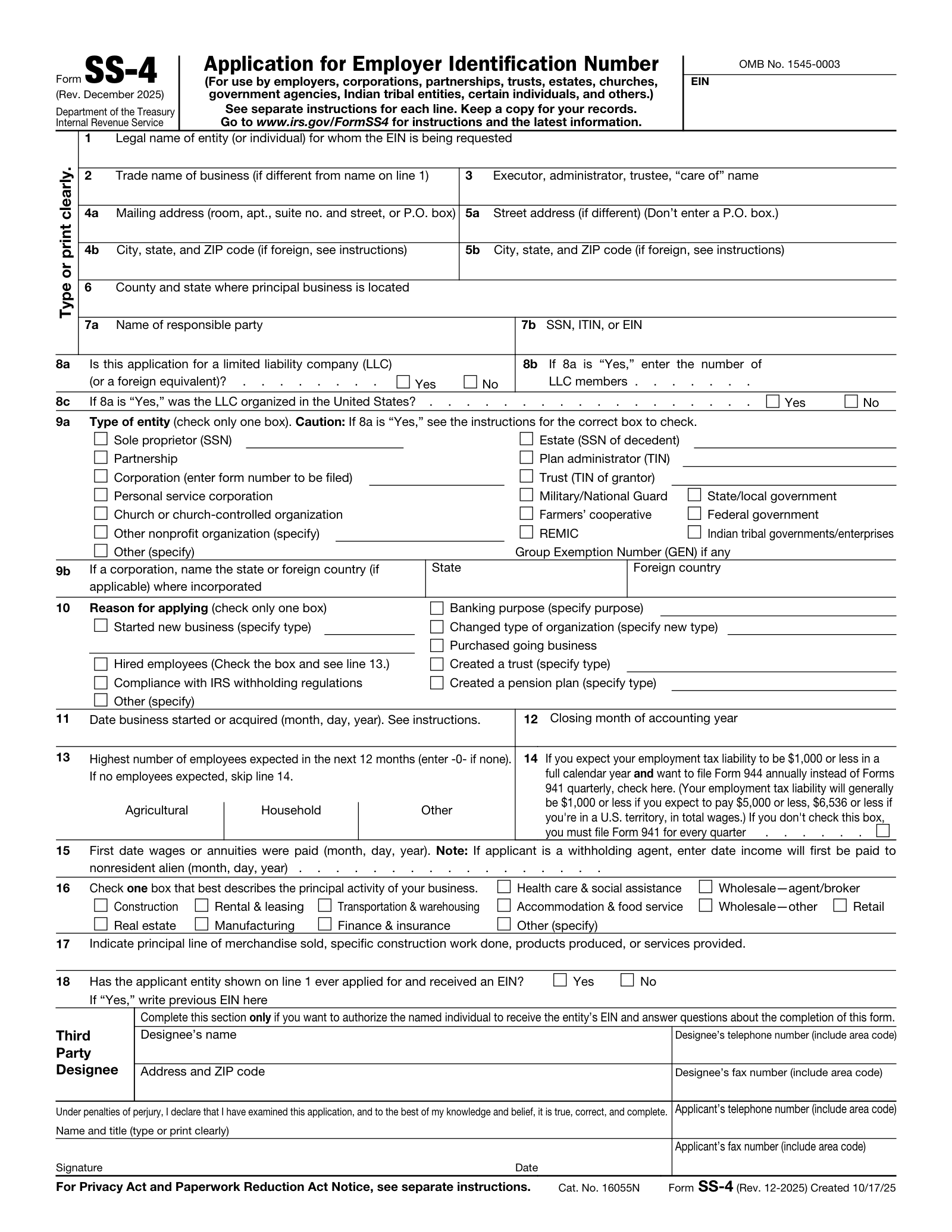
Official form (IRS.gov): Form SS-4 official PDF
| Method | Who can use it | Typical turnaround | What you need | Trade-off |
|---|---|---|---|---|
| Online | Applicants with a valid SSN, ITIN or EIN | Immediate | US tax ID for the responsible party | Not available to most non-residents |
| Fax (SS-4) | Anyone | Days to a couple of weeks | Signed SS-4, cover sheet, return fax number | You need a working fax line both ways |
| Mail (SS-4) | Anyone | Several weeks | Original signed SS-4 | Slowest route, and you wait on international post |
| Phone (international applicants) | International applicants | Often same call | Completed SS-4 in front of you | Call timing and international dialing |
| Paid agent handling fax | Anyone | Days to a couple of weeks | Signed SS-4 and authorisation | Provider fee on top of a free government number |
Turnaround figures vary with IRS workload, so treat the middle column as a planning range, not a promise
The phone route, honestly
The IRS states that international applicants may apply by phone [4]. In practice that means you call the IRS number for international callers, hold your completed SS-4 in front of you, and answer questions from the form. If the agent processes it, you get the EIN on the call.
It is the fastest legitimate path. It is also the one where a half-filled form gets you bounced, so have every field ready before you dial.
What fax and mail actually require
Fax needs a cover sheet and a return fax number the IRS can send the reply to. Mail needs the original signed SS-4, posted to the address in the instructions. Neither route accepts a scanned signature by email.
On cost: the EIN is free from the IRS. Every rupee or dollar a service charges is a provider fee, not a government fee. Separate the two when you compare options.
If you want the fax or phone handled for you, getting an EIN as a non-US resident covers the assisted route.
What information do you need before starting Form SS-4?
Six things: the exact legal name, a business address, the formation state and date, the responsible party's details, the entity type, and the reason for applying. Get all six on paper before you open the form.
Checklist:
- Legal name copied character for character from the state approval, including "LLC" or "L.L.C."
- Principal business address, which can be your registered agent's address (the local contact who receives official mail for your company) if the state allows it
- Responsible party name and address, plus "Foreign" on line 7b if you have no SSN or ITIN
- Entity type on line 9: single-member LLC, multi-member LLC, or corporation
- Date business started and closing month of the accounting year
- Reason for applying on line 10
On line 10, most new LLCs check "Started new business" or "Banking purpose." "Compliance with IRS withholding regulations" is not the default and does not apply to a plain operating LLC.
Heads-up: line 7b is the field that sinks the most non-resident applications. The SS-4 instructions tell you to write "Foreign" when the responsible party has no US tax ID. Write an ITIN you do not have, or leave it blank, and the application stalls.
For a field-by-field walkthrough, see federal tax support for Form 5472 and Form 1120.
How do you name a responsible party without an SSN or ITIN?
You name yourself. A non-resident can be the responsible party of a US LLC, and you write "Foreign" on line 7b in place of an SSN or ITIN [1]. You do not need an ITIN to get an EIN.
The responsible party is the person who controls the entity: the managing member of an LLC, the president of a corporation. That is you, the founder.
The nominee shortcut is a bad trade
Some founders list a US friend or a paid nominee to avoid the "Foreign" field. Do not do this. The responsible party must be the person who actually controls the company. A nominee creates a false record with the IRS, confuses your bank's know-your-customer checks, and gives a stranger signature authority over your tax identity.
If you later obtain an SSN or ITIN, the IRS record can be updated. The EIN itself does not change.
ITIN and EIN are different tools
An ITIN (Individual Taxpayer Identification Number, applied for on Form W-7) is for your personal tax filing. An EIN is for the business. Applying for an ITIN first adds weeks to your timeline and does not speed up the EIN at all. If you need both, run them in parallel, not in sequence.
Imagine you are a founder in Bengaluru with no US tax ID. You form a Delaware LLC, write "Foreign" on line 7b, and apply by phone. Nothing about that path requires an ITIN, and nothing about it is unusual to the IRS agent on the line.
What happens after you submit Form SS-4, and how long should you wait?
The IRS assigns the EIN and sends a CP 575 notice, the letter that states your EIN and entity details. If you applied by phone, you get the number on the call and the CP 575 follows by post. If the original letter is lost later, the IRS can issue a 147C letter as a replacement.
| Method | Typical wait | How you receive the EIN | If it does not arrive |
|---|---|---|---|
| Phone | Same call in many cases | Verbal, then CP 575 by post | Call the IRS with your SS-4 details |
| Fax | Days to a couple of weeks | Fax back to your number | Follow up by phone |
| Several weeks | Post to the SS-4 address | Follow up by phone | |
| Online (if eligible) | Immediate | Downloadable letter | Not applicable |
| Agent-handled fax | Days to a couple of weeks | Agent forwards the letter | Agent follows up |
Exact 2026 processing times need checking against current IRS guidance before you plan around them
While you wait, do not open the bank account or file returns. You can draft your operating agreement (the internal document that sets out ownership and management), prepare your bank application, and gather your formation documents.
How do you use the EIN for banking, payments, and tax filings?
The EIN is your company's tax ID. It goes on the business bank account application, the payment processor profile, and every annual return. Your personal SSN or ITIN stays separate and personal.
Banks and processors ask for the EIN plus your formation documents and ownership ID. A US LLC with a non-resident owner may make you eligible to apply, but approval stays the provider's decision. Nobody can promise it.
Payers will also ask for a tax form. A non-resident-owned entity typically provides Form W-8BEN-E (the withholding certificate for foreign entities) rather than Form W-9, which is for US persons.
The annual filing you cannot skip
A foreign-owned single-member LLC that is disregarded for US tax purposes generally files a pro forma Form 1120 with Form 5472 attached each year. The EIN is required on both. Missing this filing carries a penalty, so put it in the calendar the day the EIN arrives
The EIN does not replace an ITIN for your personal return, and it does not by itself make you a US tax resident. Ownership, US-source income, treaty position and state nexus all feed into your tax position. Get a qualified tax professional to look at your facts.
Suppose you sign up for a payment processor two weeks after the EIN lands. The onboarding form asks for the EIN, the legal name, and the country of the owner. If the name matches your CP 575 and your state filing, onboarding moves. If it does not, you are back in the queue.
How do you fix an error or get a replacement EIN letter?
The fix is a phone call to the IRS business line. Name and address corrections, and 147C replacement letters, are handled there rather than through a new application. The EIN number itself rarely changes.
Have your EIN, legal name, address and responsible party details ready. The IRS can fax or mail the 147C letter
Common fixes:
- Misspelled entity name on the IRS record
- Wrong formation date on SS-4 line 8a
- Wrong responsible party listed
- Lost CP 575, needing a 147C
If the EIN was issued to an entity that should never have existed, that is a new application, not a correction. Ask the IRS which situation you are in before you file anything.
How do you keep EIN records consistent across state and federal filings?
Use one exact legal name and one EIN on every document. State annual report, bank forms, tax returns, payment processor profiles, the FinCEN beneficial ownership filing if it applies to you. Mismatches are what slow everything down.
The name-change case is the one people forget. If your LLC changes its name, or moves state, update the IRS record, then the bank, then the processor. Keep the CP 575 or 147C with your company records permanently, because you will be asked for it again.
Common Mistakes
- Applying before the state approves the LLC. The formation date on line 8a must be real. Wait for the approval.
- Writing an ITIN that does not exist on line 7b. Write "Foreign." That is the instruction.
- Using a nominee responsible party. It creates a false IRS record and trips bank checks. Name the person who actually controls the company.
- Trying the online portal without a US tax ID. It will stop you at the identity step. Use fax, mail or phone instead.
- Name mismatch between SS-4, CP 575 and the state filing. Copy the legal name character for character.
- Losing the CP 575 and discovering it at bank onboarding. Request the 147C before you need it, not after.
- Forgetting the annual Form 5472 filing. The EIN exists so the IRS can match that return to your entity.
Frequently Asked Questions
Can I get an EIN without an SSN or ITIN? Yes. Apply by fax, mail, or phone. Write "Foreign" on Form SS-4 line 7b instead of a US tax ID.
Should I form my LLC before applying for an EIN? Yes. The SS-4 asks for formation state and date, and the IRS expects the entity to exist. Apply after state approval, using the exact legal name.
How long does an EIN take for a non-resident? Phone can be same-day in many cases. Fax runs days to a couple of weeks, mail several weeks. Check current IRS guidance before you plan around a number.
Do I need an ITIN to open a US business bank account? Usually no. Banks ask for the EIN, formation documents and ownership ID. An ITIN is for personal tax filing.
What is the difference between a CP 575 and a 147C letter? CP 575 is the notice issued when the EIN is assigned. 147C is the replacement verification letter the IRS sends if the original is lost.
Can I use a friend or nominee as the responsible party? It is possible on paper and a bad idea in practice. It creates compliance and banking risk. Use the person who controls the entity.
Is the EIN free? Yes, the IRS charges nothing. Any fee you pay is a service fee, not a government fee.
What to do next
Form the LLC. Wait for the state approval. Fill every SS-4 field, write "Foreign" on line 7b, and call the IRS international line with the form in front of you. That is the whole sequence, and it costs nothing but a phone call.
If you want help with US LLC formation, EIN and business setup, NexFyla can assist. We help non-US founders form US companies and set up EIN and US business banking support. You can also see NexFyla pricing and package costs before you decide.
*Last updated: February 2026.*