Table of Contents
▼
How long does an ITIN application actually take in 2026?
The IRS works a complete Form W-7 in about 7 to 11 weeks from the day it lands in the IRS mailroom. Peak season pushes you toward the top of that range. The IRS will not quote you a single firm date, and you should not plan around one.
Quick Answer: An ITIN application takes roughly 7 to 11 weeks of IRS processing once a complete Form W-7 reaches the IRS. Applications filed January through April run longer. If you mail your passport instead of using a Certifying Acceptance Agent, add several weeks of transit in each direction, and the passport comes back separately after the ITIN is issued.
Two clocks run at once, and only one of them is yours to control.
- The IRS clock. Adjudication. Weeks, not days. You cannot buy your way to the front of it.
- The mail clock. Transit to the IRS and back, plus the return of your original documents. This is the leg a Certifying Acceptance Agent removes.
The clock starts when the IRS receives a complete application, not when you post it. So "processing time" and "time until the ITIN is in your hand" are different numbers, and the gap between them is where founders lose launch dates.
The IRS publishes its ITIN guidance on irs.gov and describes the application and renewal routes without promising a fixed turnaround [1][4]. Treat every published figure, including the range above, as a range that shifts year to year. Confirm the current window on irs.gov before you commit a date to anyone.
Why "how long does it take to get an ITIN" has no single answer
Because you are asking two questions at once. How fast does the IRS adjudicate, and how long do your documents spend in transit? A founder in Bengaluru who mails an original passport and a founder in the same city who uses a CAA submit on the same day and get their ITINs weeks apart.
Which filing method is fastest: mail, IRS office, or a Certifying Acceptance Agent?
A Certifying Acceptance Agent (CAA) is fastest end-to-end for most overseas founders. The CAA verifies your passport and forwards a certified copy, so your passport never leaves your hands and you skip the document-return leg entirely. Mail is slowest. In-person at an IRS Taxpayer Assistance Center is fast but you have to be standing in the United States.
| Method | Who handles your documents | IRS clock | Mail clock | Passport leaves your hands? | Best for |
|---|---|---|---|---|---|
| Mail to IRS | You post originals | 7-11 weeks | Weeks each way, plus document return | Yes | Founders with no deadline and no travel plans |
| IRS Taxpayer Assistance Center | IRS staff verify in person | 7-11 weeks | None | No | Founders already in the US |
| Certifying Acceptance Agent | CAA certifies and forwards | 7-11 weeks | Minimal | No | Most non-US founders |
| Acceptance agent | Agent verifies, you still mail originals | 7-11 weeks | Weeks each way | Yes | Rarely worth it over a CAA |
The government side is the same whichever route you pick. Form W-7 itself carries no IRS filing fee, so the difference is service cost and time, not a government charge. Check the current IRS fee schedule before you budget, since fee tables get revised.
A CAA charges a service fee. That is a provider cost, not a government fee, and you should see it quoted separately. The trade is simple: you pay for someone to certify your passport so you keep it, and you cut weeks of transit out of the timeline.
Say your passport is your only photo ID and you have an international trip in six weeks. Mailing it to the IRS in Austin means you either cancel the trip or delay the application. A CAA certifies a copy in one appointment and you keep the original in your bag.
Why does tax season add weeks to ITIN processing?
January through mid-April is when ITIN applications and tax returns both peak. The IRS works through a bigger queue with the same staff, so the same application that clears in seven weeks in August can sit for eleven in March. The IRS itself ties the wait to application volume rather than to any published service standard [1][4].
There is a second effect that catches people. If you attach Form W-7 to a tax return, the ITIN is processed as part of that return. The return's own processing time stacks on top of the ITIN clock. A standalone W-7 filed in July is a different animal from a W-7 stapled to a 1040 in March.
A rough seasonal map, offered as guidance rather than an IRS-published tier:
- Peak: January to mid-April. Longest waits.
- Shoulder: May to June, September to October. Middling.
- Quietest: July to August, November to December. Best odds of the short end.
Do file in the quiet window if your tax situation allows it. If you must file in peak season, add four weeks of buffer to any banking or Stripe launch date you have promised a customer.
What can you set up before the ITIN arrives?
Most of your US stack. The EIN (the company's employer identification number) comes from Form SS-4 and does not need your ITIN. State formation does not need it. A business bank account and a Stripe account can usually be started with your passport and the EIN, with the ITIN added later for tax filings.
Sequence it like this:
- Form the entity at state level.
- Get the EIN on Form SS-4. If you are getting an EIN as a non-US resident, the fax route matters because the online portal wants an SSN.
- Open banking and Stripe with passport plus EIN.
- Add the ITIN when your tax return or withholding paperwork needs it.
Three IDs get confused constantly. Keep them apart:
- ITIN: your personal taxpayer number, for people without an SSN.
- EIN: the company's number.
- Form W-8BEN / W-8BEN-E: withholding certificates. Not ID applications at all.
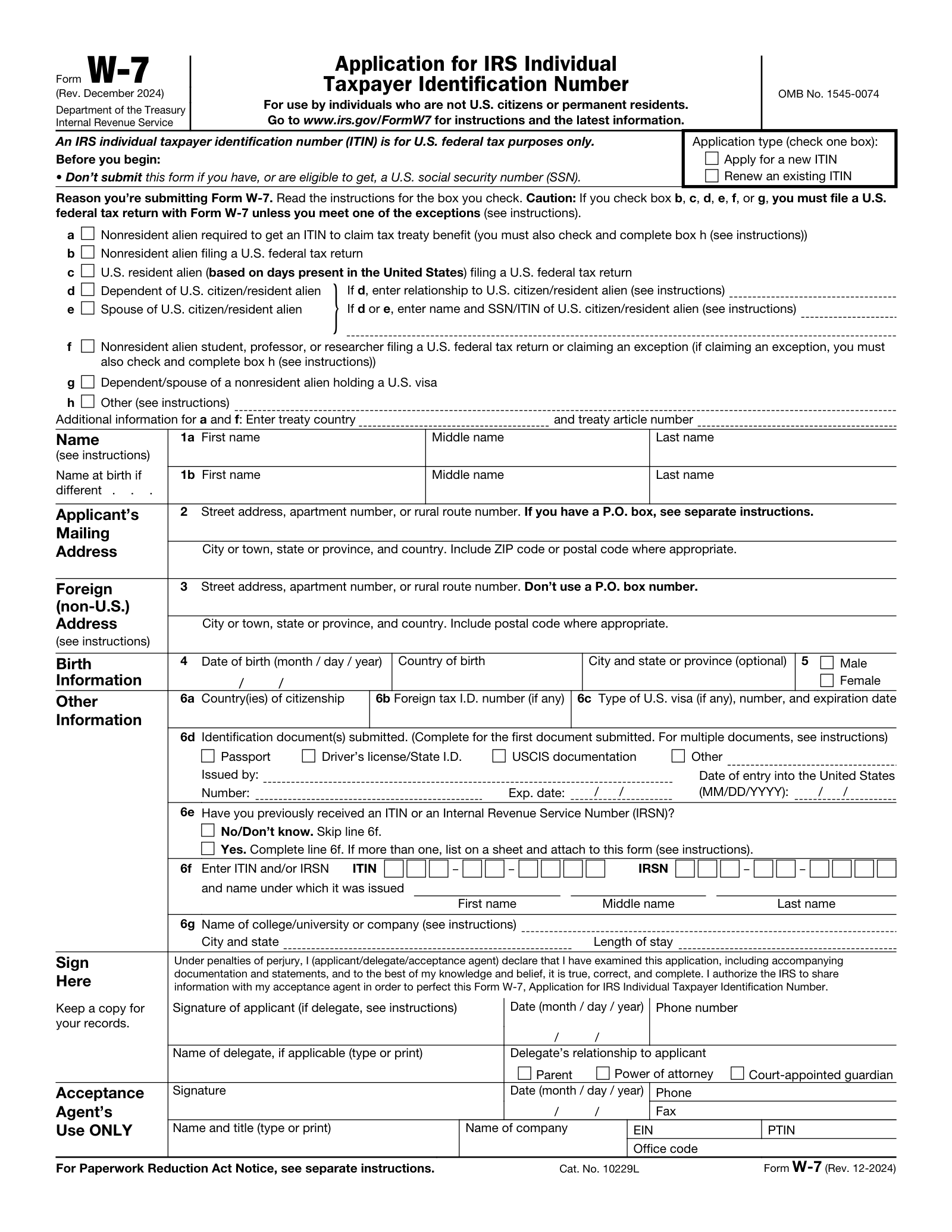
Official form (IRS.gov): Form W-7 official PDF
Here is the honest limit. Some banks and payment providers do ask for the ITIN of the beneficial owner. That is a provider policy decision, not a law, and it changes. Confirm with each provider before you promise a launch date. An LLC makes you eligible to apply for an account. Approval stays with the provider.
Suppose Stripe asks for the beneficial owner's tax ID during review. You have the EIN and passport ready, so you answer what you can and add the ITIN when it lands. Nothing about that review is guaranteed, so keep a backup processor in mind.
When should you follow up with the IRS about a pending ITIN?
Wait until the published window has clearly passed, roughly 9 to 11 weeks from IRS receipt, then call the IRS ITIN line. Calling at week four just burns your morning.
Have these in front of you before you dial:
- A copy of the W-7 you filed
- The date you mailed it and the certified-mail tracking number
- Any IRS notice you have received, by number
Notices matter. A CP566 or CP567 letter means the IRS wants more information or a document. Respond promptly. Ignore it and the application stalls, and the clock effectively restarts when you finally answer.
There is no paid expedite. None. The only real speed-up is fixing an incomplete application. Anyone selling you "expedited ITIN processing" is selling preparation speed, not IRS queue position.
If you would rather hand the whole sequence to someone who does it weekly, applying for an ITIN with Form W-7 support is the route most founders take.
What makes an ITIN application slow or get rejected?
Incomplete paperwork, not IRS backlog. Missing or uncertified documents, name mismatches, and applications filed without the required tax return cause most of the delay you can actually prevent.
The usual suspects:
- An expired passport
- A plain photocopy where a certified copy was required
- The wrong reason-for-applying box ticked
- No signature
- A standalone W-7 when a return was required
Renewals are the trap nobody warns you about. Certain ITINs expire, and the IRS identifies them by middle digits. A renewal is processed like a new application, so it takes the same weeks. Check your number before you file anything, not after.
Run this checklist before anything leaves your desk: passport valid, name spelled exactly as on the passport, reason box correct, signature present, supporting return attached if required.
Imagine your passport reads "Kumar, Arjun R." and your W-7 reads "Arjun Kumar." Small mismatch, real delay. The IRS matches documents, and a mismatch sends the file sideways.
Common mistakes that stretch ITIN timelines
Mailing an original passport when a CAA could have certified it. That single choice adds the document-return leg, and your passport comes back separately from the ITIN letter.
Booking a bank or Stripe launch around the ITIN when the EIN and passport would have unblocked you. Most founders wait weeks for a number they did not need yet.
Assuming the IRS expedites for a fee. It does not.
Filing in peak season with no buffer, then blaming the provider when the ITIN is late.
Confusing the ITIN with the EIN, or with W-8BEN and W-8BEN-E, and filing the wrong form entirely.
Ignoring an IRS notice and letting the application sit.
What is a realistic ITIN timeline for a non-US founder in 2026?
Plan for 8 to 12 weeks end-to-end via a CAA in the quiet season, and 12 to 16 weeks via mail in peak season. Then build your banking and Stripe dates around the longer number. If you beat it, you look organized. If you plan around the short number and miss, you look unreliable to every customer waiting on checkout.
A working timeline:
- Week 0: prepare the W-7, get documents certified, confirm your name matches your passport exactly
- Weeks 1-2: submit through your chosen route
- Weeks 3-11: IRS processing
- Week 12 onward: ITIN in hand. Mail adds the return transit on top.
While that runs, you form the entity, get the EIN, open banking, set up Stripe, and start bookkeeping. None of it waits for the ITIN. If you want the banking side handled alongside formation, opening a US business bank account is the step to line up in week two, not week twelve.
One caveat worth repeating. IRS windows are ranges and they change year to year. Confirm the current figure on irs.gov before you put a date in a contract.
Frequently Asked Questions
How long does ITIN processing take in 2026? Roughly 7 to 11 weeks from IRS receipt for a complete W-7. Peak season runs longer. Add mail transit if you post originals.
Is a CAA faster than mailing my passport to the IRS? Usually yes end-to-end. The CAA certifies your passport, so you avoid the document-return leg entirely.
Can I open a US bank account or Stripe before my ITIN arrives? Often yes, with passport and EIN. Some providers ask for the ITIN of the beneficial owner, so confirm with each one. Approval is always the provider's call.
Can I pay to expedite an ITIN application? No. The IRS offers no paid expedite. Fixing an incomplete application is the only real speed-up.
How do I check my ITIN application status? Wait until the published window passes, then call the IRS ITIN line with your W-7 details and any notice number.
Does an expired ITIN take as long to renew? Yes. A renewal is processed like a new application, so plan the same window.
NexFyla helps non-US founders form US companies and set up EIN and US business banking support. If you want help with US LLC formation, EIN and business setup, NexFyla can assist, and you can see NexFyla pricing before you decide.
*Last updated: February 2026.*
Related reading
Ready to act on this? ITIN application help takes the filing, registered agent and paperwork off your desk.