Table of Contents
▼
What is a tax ID, and why does the US use more than one?
A tax ID is a Taxpayer Identification Number (TIN). The IRS uses several TIN types because it identifies businesses and individuals separately: an EIN for entities, an SSN for citizens and eligible workers, and an ITIN for individuals without an SSN who need to file a US return [1].
Quick Answer: A US tax ID is any TIN the IRS uses to identify a taxpayer. Your LLC gets an EIN (Employer Identification Number) from the IRS for free. You personally get an ITIN (Individual Taxpayer Identification Number) only if you have your own US filing obligation. They are two different numbers for two different taxpayers, and neither one replaces the other.
That mental model carries the rest of this article. One number identifies your company. Another number, if you ever need one, identifies you. They sit on different lines of different forms, and mixing them up is the single most common paperwork error I see from non-US founders.
The TIN family includes SSN, EIN, ITIN, ATIN and PTIN [1]. Only two matter to you: EIN and ITIN. An ITIN is a 9-digit number the IRS issues when you need a US taxpayer identification number but are not eligible for an SSN [2].
One formatting detail worth knowing: ITINs start with the digit 9, and the fourth digit is a 7 or 8.
EIN: who is it for and what does it cover?
An EIN is the IRS number for your LLC. It is free from the IRS and you request it on Form SS-4. It is the number your company uses for banking, payroll and tax filings.
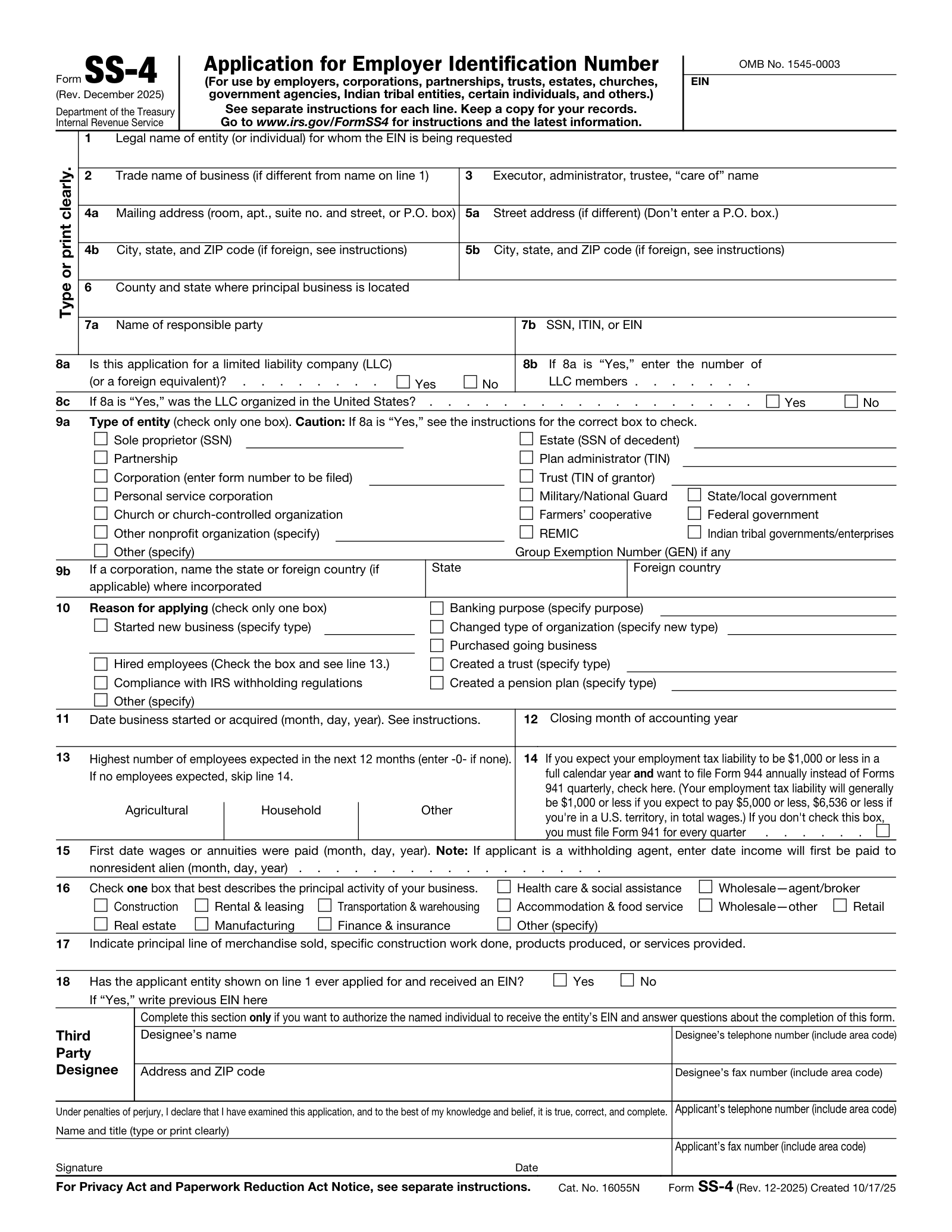
Official form (IRS.gov): Form SS-4 official PDF
Who actually needs one:
- Multi-member LLCs, always.
- Any LLC opening a US business bank account, because banks run KYC on the entity and the EIN is the entity's identifier.
- Employers with US payroll.
- Foreign-owned single-member LLCs, which must file Form 5472 with a pro forma Form 1120 under that EIN.
Here is the part most guides bury: a non-resident does not need an SSN or ITIN to get an EIN [5]. The SS-4 asks for the responsible party's name and taxpayer ID, but a foreign founder without a US number can still apply. That is the whole reason the fax and mail routes exist.
Say your LLC is formed in Wyoming and you are in Pune. You fill out Form SS-4 with the LLC's name, your foreign address, and yourself as responsible party. You tick the box for the Third-Party Designee section if an agent is handling it, then fax it to the IRS international line. The EIN comes back by fax, and the CP 575 notice follows by mail.
On cost: the EIN itself is $0 from the IRS. Any fee you see is a provider or agent charge for handling the fax or the application, not a government fee.
If you are mapping the full sequence from state filing to bank account, the US LLC formation for non-residents path shows where the EIN step sits.
ITIN: who is it for and when is it actually required?
An ITIN is a personal number for an individual who has a US federal tax filing or reporting obligation and is not eligible for an SSN [2][3]. It is not a business number. It is not a work permit.
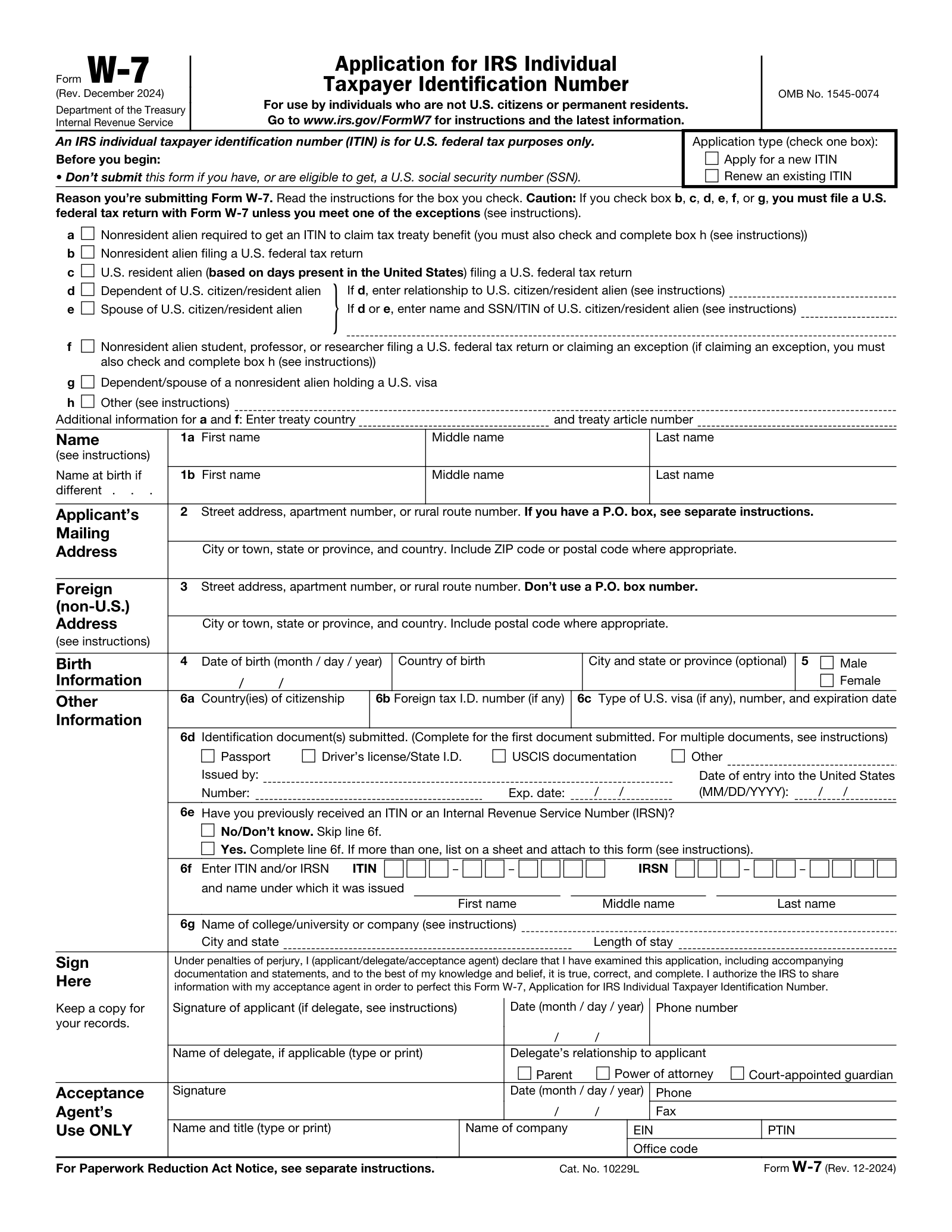
Official form (IRS.gov): Form W-7 official PDF
The trigger for a non-resident founder is narrow. You need an ITIN when you personally file a US return, for example a Form 1040-NR on US-source income, a treaty or withholding situation that requires your own number, or a refund claim [2]. Running an LLC is not, by itself, that trigger.
What an ITIN does not do:
- It does not authorize you to work in the US.
- It does not change your immigration status.
- It does not replace your LLC's EIN.
People without lawful status can obtain an ITIN, because the number exists for tax administration, not immigration [9]. Treat it as a filing tool, nothing more.
Application runs through Form W-7 with certified identification documents. There are three routes: mail, an IRS Taxpayer Assistance Center, or a certified acceptance agent [3].
Heads-up: ITINs expire after a period of non-use, and renewal means filing again.
Do you need an ITIN to form an LLC or open a bank account?
No. Forming an LLC is a state function and needs no IRS number at all. Opening a US business bank account needs the LLC's EIN, not your ITIN.
Break the myth into its parts:
- State formation: Articles of Organization and a state fee. No tax ID.
- EIN: the entity's number, from the IRS.
- Bank KYC: EIN, formation documents, your passport, proof of address.
- Personal filing: the only place an ITIN enters the picture.
What banks actually ask a non-resident owner for is the entity's EIN plus tax forms: W-8BEN-E for the entity and W-8BEN for the individual. Neither asks for a US ITIN. The W-8BEN asks for your foreign tax identifying number, meaning your home-country tax ID, which is a different thing [6].
Suppose a bank asks for your "tax ID" and you hand over an ITIN you happened to have. You have now told the bank an individual number belongs to an entity. That mismatch creates withholding and 1099 reconciliation problems later. Give the EIN where the entity is the payee.
| EIN | ITIN | |
|---|---|---|
| Identifies | Your LLC or business | You, personally |
| Issuing form | Form SS-4 | Form W-7 |
| IRS fee | $0 | $0 |
| Needed to form an LLC | No | No |
| Needed to open a US business bank account | Yes (the entity's) | No |
| Needed to file a personal US return | No | Yes |
The banking step itself has its own checklist, covered in opening a US business bank account as a non-resident.
How EIN and ITIN work together for a non-resident owner
They operate at two levels. The LLC files and reports under its EIN. Any personal US return you file uses your ITIN. Most founders only ever need the first one.
Walk the foreign-owned single-member LLC case. The LLC gets an EIN. Each year it files Form 5472 attached to a pro forma Form 1120, under that EIN. Your ITIN is not required for that filing. The form reports transactions between the LLC and its foreign owner, and the owner is identified by name and address, not by a US personal number.
When both numbers exist: you have US-source income or another personal filing obligation, so you get an ITIN alongside the LLC's EIN. Keep them on separate lines of every form. The entity's number never goes on your 1040-NR, and your ITIN never goes on the 5472 as the filer's EIN.
On classification: a single-member LLC owned by a non-resident is disregarded by default for US tax purposes, and Form 8832 is only relevant if you elect corporate treatment.
Imagine you take a US consulting client who pays your LLC. The client asks for a W-9. You are not a US person, so you do not give one. You provide a W-8BEN-E for the LLC instead, with the EIN on it. Your ITIN stays out of that exchange entirely.
Applying for each without a US address
Both numbers are obtainable from abroad. The EIN comes by fax or mail on Form SS-4, because the online EIN assistant is not open to applicants without an SSN or ITIN. The ITIN comes by mail or through a certified acceptance agent on Form W-7 [3][5].
EIN route: complete the SS-4, use your foreign address, and fax it to the IRS international line. Expect the EIN back by return fax. Keep the CP 575 notice. If you lose it, request a 147C letter, which is the IRS's replacement confirmation of your EIN.
ITIN route: W-7 plus your passport, either the original or a certified copy depending on the route. Do not mail your only passport.
Government versus provider cost, kept separate:
| Item | Who charges | Amount |
|---|---|---|
| EIN | IRS | $0 |
| ITIN | IRS | $0 |
| W-7 document certification | Acceptance agent or certifying office | Varies by provider |
| EIN fax or application handling | Agent service | Varies by provider |
| Registered agent, annual state fee | State and agent | Not a tax ID cost |
If the SS-4 comes back rejected, the usual cause is a missing or incomplete responsible party section. If a W-7 is rejected, it is almost always uncertified or missing identification documents. Fix the specific field and resubmit; do not start over.
Common Mistakes
Using an ITIN where an EIN belongs, or the reverse, is the error that costs the most time. Here are the specific failure modes.
- Putting your personal ITIN on entity bank or tax forms. The entity is identified by its EIN. Fix: use the EIN on every entity document.
- Skipping the EIN because you think your ITIN covers the LLC. It does not. Fix: file Form SS-4 for the entity.
- Missing the Form 5472 and pro forma 1120 filing because "the LLC made no money." The obligation exists regardless of profit. Penalties apply for failure to file.
- Letting an ITIN expire unnoticed. Renewal means filing again. Fix: diarise the expiration.
- Mailing original ID documents. Fix: use a certified acceptance agent and keep your passport.
- Treating your foreign TIN as a US ITIN on W-8BEN. They are different numbers for different countries. Fix: enter your home-country tax ID in the foreign TIN field [6].
- Assuming an EIN means the LLC is registered in the state. State registration and IRS numbers are separate systems. Fix: confirm your state filing independently.
Records to keep for both numbers
Keep three things: the IRS-issued notices, a one-page map of which number goes on which form, and a copy of every form you filed.
The map matters more than the notices. Which number on which form:
- Form SS-4: the entity. You are the responsible party, identified by name and address.
- Form W-9: only if you are a US person. Usually not you.
- Form W-8BEN: you, individually, with your foreign TIN.
- Form W-8BEN-E: the entity, with the EIN.
- Form 5472 and pro forma 1120: the entity's EIN.
- Form 1040-NR: your personal ITIN.
Store digital copies in one folder, note who the responsible party is, and update the IRS when the responsible party or address changes. If the CP 575 is lost, request a 147C letter.
Suppose you sell the LLC or bring in a co-owner. The new owner needs the EIN, the formation documents and the filing history. A folder with the CP 575, the 5472 filings and the number map makes that handover clean.
Which one do you need? Start with the EIN, because the LLC needs it for banking and for its annual 5472 filing. Add an ITIN only when you personally have a US return to file. If you want help with the entity side, getting an EIN as a non-US resident walks the SS-4 route step by step, and federal tax support for Form 5472 and Form 1120 covers the annual filing that follows.
Frequently Asked Questions
Can I get an EIN without an SSN or ITIN? Yes. The SS-4 does not require one, and non-residents apply by fax or mail [5].
Do I need an ITIN to open a US business bank account for my LLC? No. The bank wants the LLC's EIN plus your passport and ownership documents. An ITIN is a personal number.
Is an ITIN the same as an EIN? No. The EIN identifies the entity; the ITIN identifies an individual without an SSN. Both are TINs and neither is interchangeable [1].
When would a non-resident founder actually need an ITIN? Only when you personally have a US filing or reporting obligation, such as a Form 1040-NR. Forming and running the LLC does not require it [2].
How much does each cost? Both are free from the IRS. Any charge is a provider or agent fee for document certification or application handling.
Does my foreign-owned LLC have to file anything with its EIN? Yes. A foreign-owned single-member LLC files Form 5472 with a pro forma Form 1120.
If you want help with US LLC formation, EIN and business setup, NexFyla can assist. Start with the entity number, then decide whether you personally need one at all.
*Last updated: February 2026.*