Table of Contents
▼
What is an EIN, and which foreign-owned entities actually need one?
An EIN is the IRS's free federal tax ID number for a business. A foreign-owned US entity needs one to file its federal returns, open a US business bank account, and give US payers the number they ask for on a W-9.
Quick Answer: An EIN (Employer Identification Number) is a nine-digit tax ID the IRS issues to businesses for free. A non-US resident who owns a US LLC or corporation needs an EIN to file federal tax returns, open a US bank account, and get paid by US customers. You apply on Form SS-4, and the IRS expects your entity to exist before you apply.
Sequence matters. The IRS tells applicants to form the legal entity first, then apply for the EIN [5]. That order is not bureaucratic fussiness. The name on your SS-4 has to match the name on your Articles of Organization (the state filing that creates your LLC) or your certificate of incorporation. Get the order wrong and the application bounces.
Which structures need one:
- A US LLC with one or more members, including a single foreign owner.
- A US corporation, whether C-Corp or S-Corp.
- A partnership with US filing obligations.
- A foreign entity that has a US trade or business or US withholding obligations.
Three things the EIN is not. It is not a visa or work authorization. It is not a bank account. And it is not an ITIN, which is the individual taxpayer ID a person applies for on Form W-7. Keep those separate in your head, because the IRS keeps them separate in its systems.
If the entity does not exist yet, stop here and sort that first. Our guide to US LLC formation for non-residents covers the state filing step.
Which Form SS-4 fields do foreign applicants most often get wrong?
The recurring failures are the legal name, the entity-type and LLC count lines, the reason-for-applying code, and the responsible party block. Four fields, most of the returns.
Form SS-4 is the IRS application for an EIN. It is two pages, and it is not hard. It is just unforgiving about exactness.
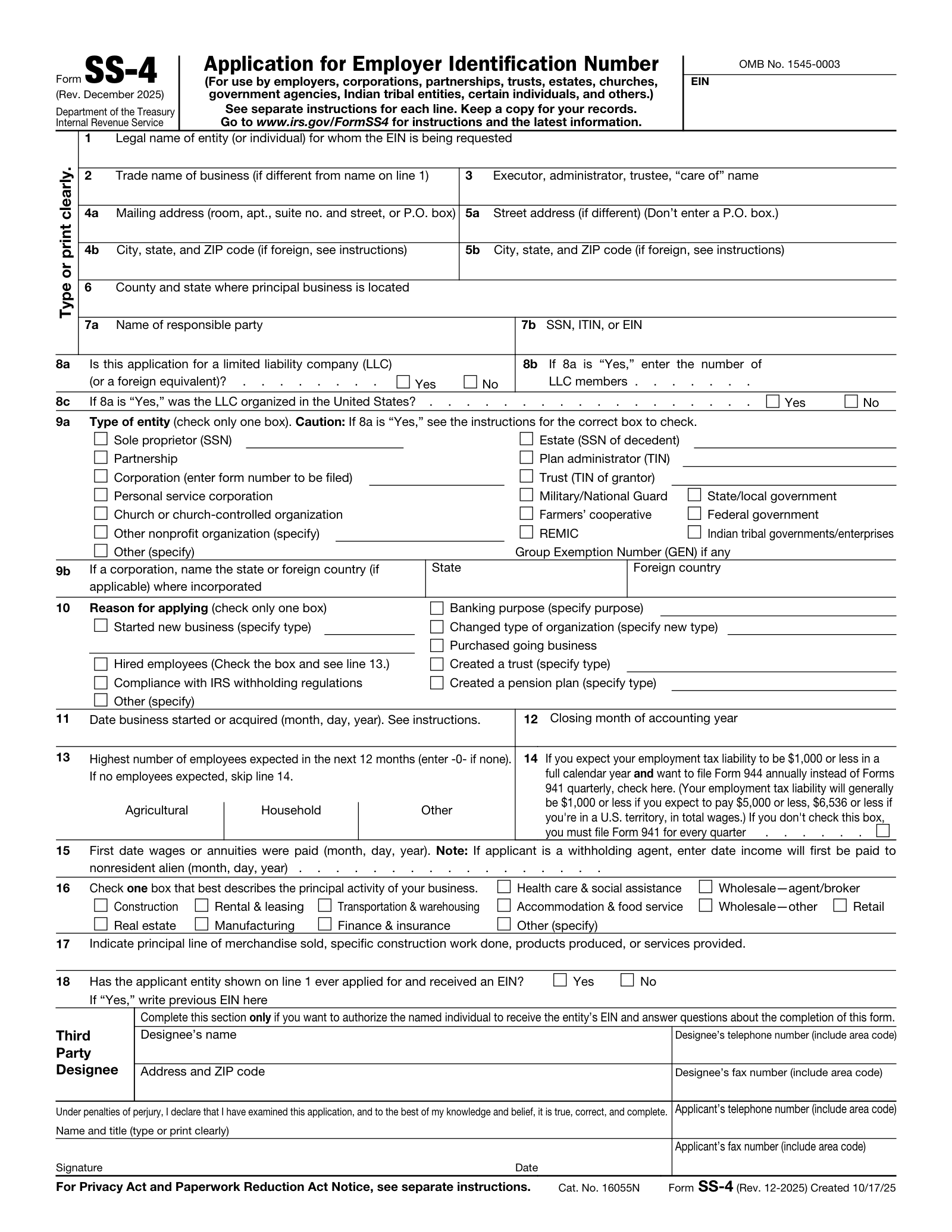
Official form (IRS.gov): Form SS-4 official PDF
Walk the lines in order and the form makes sense.
Line 1, legal name. Copy it character for character from the state formation document. If the state approved "Nexfyla Technologies LLC," you do not write "Nexfyla Tech." A mismatch here is one of the most common reasons an SS-4 comes back.
Line 2, trade name. Only fill this if you actually operate under a different name. If you trade as "Nexfyla," put that here. Do not swap the two lines.
Lines 3 and 4, mailing address and country. Use an address where you actually receive mail. It does not have to be in the US. Put your country code in line 4 if you are outside the US.
Line 7, entity type. Check one box only. A US LLC is "Limited liability company." A corporation is "Corporation." Do not check two.
Lines 8 and 9, the LLC block. Line 8 asks how many members the LLC has. Line 9 asks whether the LLC is filing as a corporation, which connects to Form 8832 (the entity classification election). Answer these honestly, because they change what the IRS expects you to file later. A single-member LLC owned by a foreign person has its own return obligations, covered below.
Line 10, reason for applying. This is where applicants guess. The codes are specific: starting a new business, banking, compliance with IRS withholding, and so on. Pick the code that matches your actual reason. If you need the number to open a bank account, say so. Do not default to "started new business" because it sounds neutral.
Say your state formation document lists "Aurora Labs LLC" but you typed "Aurora Lab LLC" on line 1. The IRS matches names against the formation record, and a one-letter gap can trigger a return. You fix it by refiling with the exact name, and you lose the weeks you spent waiting.
Who can be the responsible party when no one has an SSN or ITIN?
The responsible party must be a natural person who controls the entity. An SSN or ITIN is requested on the form, but the SS-4 instructions allow an entry where the person has none, so a non-resident owner with no US tax ID can still be the responsible party.
Who qualifies: an owner, a managing member, a principal officer. Not a company. Not a nominee registered agent service acting as a stand-in. The IRS wants a human who actually controls the entity.
This trips people up because the responsible party's name is what banks and payers see on EIN lookups. If your LLC's responsible party is you, your personal name sits in the IRS record. That is normal, and it is not a privacy problem you can solve by naming someone else.
The ITIN track is separate. If you want an individual taxpayer ID for yourself, that is Form W-7, not the SS-4. Do not conflate them. Filing a W-7 does not get your LLC an EIN, and getting an EIN does not get you an ITIN. If you need the individual number, our page on applying for an ITIN walks that process.
Note: the current SS-4 instructions spell out exactly what to enter when the responsible party has no SSN or ITIN. Read the instruction page for the revision you are filing, not a blog summary from three years ago.
Fax, phone, or mail: which EIN application route fits a non-resident?
The online EIN assistant requires an SSN or ITIN and a US address, so non-residents use fax, the international phone line, or mail. Fax is the fastest of the three when you supply a return fax number.
Official form (IRS.gov): Form SS-4 official PDF
| Route | Who it suits | What you supply | Timing |
|---|---|---|---|
| Online assistant | Applicants with an SSN/ITIN and US address | Online form | Immediate per the IRS [1] |
| Fax | Most non-residents | Completed SS-4 plus a return fax number | IRS states it faxes the EIN back within about four business days |
| Phone (international) | Applicants who can call the US | SS-4 details read aloud | EIN issued by fax or mail after the call |
| Anyone, slowest | Completed SS-4 to the IRS campus address in the instructions | Weeks, not days |
The IRS describes the online route as free and immediate [1][7]. That is true for the people who can use it. Non-residents generally cannot, because the assistant wants a US address and a US tax ID for the responsible party.
Fax mechanics. Fill the SS-4, sign it, and fax it to the number in the current instructions. Include a cover sheet with your return fax number clearly written. The IRS states it will fax the EIN back within about four business days when you provide that number. If your fax is illegible, you get nothing back, and you will not know why.
Phone route. International applicants can call the IRS and complete the SS-4 verbally. Have the form filled out in front of you before you dial. Reading answers cold off a screen while an agent waits is how fields get mistyped.
Mail route. Slowest, but it works when your fax situation is unreliable. Use the campus address printed in the current SS-4 instructions, not an address from an old forum post.
Heads-up: no provider can guarantee how fast the IRS processes your application. Anyone promising a fixed turnaround is quoting their own workflow, not the IRS's.
Why do EIN applications get returned, and how do you avoid it?
Returns come from incomplete fields, name mismatches, an unsigned form, or an unreachable fax number. They do not come from the applicant being foreign.
Fix these before you send:
- Name mismatch. Compare line 1 against the state formation document, letter by letter.
- Missing reason code. Line 10 left blank or filled with a code that does not match reality.
- Unsigned form. The SS-4 needs a signature from the responsible party. A typed name is not a signature.
- Bad fax number. If the return fax number is wrong or missing, the IRS has nowhere to send the EIN.
- Two entity types checked. Line 7 takes one box.
Part II, the third-party designee box. This is the field almost nobody explains. Naming a designee, with a signed authorization and a five-digit number you choose, lets that person discuss the application with the IRS on your behalf. If your accountant or agent is handling the filing, fill this in. Without it, the IRS will not talk to them about your application, and a stuck file stays stuck.
Suppose your fax went out three weeks ago and nothing came back. First, check the fax confirmation for a completed transmission. Then call the IRS international line with a copy of the SS-4 in front of you and ask for status. If the form was returned, they will tell you which field failed.
What changes once the EIN is issued?
Store the CP 575 notice, give the EIN to your bank and payers, and calendar the federal filings that now apply. The EIN is the start of your compliance calendar, not the end of it.
The CP 575 is the IRS notice that states your EIN. Keep the PDF or paper copy. Banks ask for it during onboarding, and it is the cleanest proof you have.
The filing stack for a foreign-owned single-member LLC. You file Form 5472 together with a pro forma Form 1120. This is an information return, and the penalties for missing it are real. Confirm the current penalty figure on the IRS site before you rely on any number you read elsewhere.
Corporations file Form 1120, or Form 1120-S if an S-Corp election is in place. Partnerships file Form 1065.
Payer documentation. A US payer will usually ask the entity for a Form W-9, because the entity is a US person for tax purposes. A foreign payer asks for Form W-8BEN-E instead. Get both straight before a client asks you for one.
Tax treatment depends on ownership, US-source and effectively connected income, any treaty position, and state nexus. No article can tell you your bill. A qualified tax professional can. For the filing mechanics, see federal tax support for Form 5472 and Form 1120.
Which EIN mistakes end up hurting banking and payments?
Name and address inconsistencies between the EIN record, the formation documents, and the bank application cause the most downstream pain. The EIN is not a bank account, and it does not grant payment processing on its own.
Banks and fintech providers run their own onboarding. An EIN may make your LLC eligible to apply. Approval stays the provider's decision, and no honest service can promise it.
Imagine your EIN record lists your India address, your formation documents list a Wyoming registered agent address, and your bank application lists a third address. That is three addresses across three systems, and a compliance reviewer has to reconcile them. Expect a request for more documents.
One entity, one EIN. A second EIN for the same LLC is generally unnecessary and creates confusion. Certain structural changes, like converting entity type or forming a new entity, do require a new EIN. Check the IRS guidance on when a new EIN is needed before you apply for another one.
Tip: before you open a bank account, line up your legal name, your EIN record, and your formation documents so all three match. It saves a review cycle. Our guide to opening a US business bank account covers what providers ask for.
Common Mistakes
- Applying before the entity exists. The IRS expects formation first [5]. An SS-4 filed against a company that does not exist yet gets rejected.
- Using a trade name as the legal name. Line 1 is the legal name. Line 2 is the trade name. Swapping them causes a mismatch.
- Skipping the designee box. If an agent files for you, Part II is what lets them follow up.
- Paying a third party for the number itself. The IRS issues EINs free [1]. Third parties charge for assistance, not for the EIN.
- Guessing the reason-for-applying code. Pick the code that matches your real reason.
- Forgetting Form 5472. A foreign-owned single-member LLC that files nothing still has an information return due.
Frequently Asked Questions
Can a non-resident get a US EIN without an SSN or ITIN? Yes. The SS-4 responsible party block accommodates applicants with no US tax ID. The online assistant is the part that requires one.
Is the EIN free from the IRS? Yes. The IRS issues EINs at no charge [1]. Third parties charge for help, not for the number.
How long does a faxed SS-4 take? The IRS states it faxes the EIN back within about four business days when you supply a return fax number. No provider can guarantee that timing.
Can my accountant or agent handle the application for me? Yes, through the third-party designee box in Part II, with a signed authorization and a five-digit number.
Do I need a new EIN if I add a member or change entity type? Sometimes. Certain structural changes require a new EIN. Check the IRS guidance on when a new EIN is needed.
What do I do with the EIN after I receive it? Keep the CP 575 notice, give the number to banks and payers, and calendar your Form 5472 and Form 1120 obligations.
NexFyla helps non-US founders form US companies and set up EIN and US business banking support. If you want help with US LLC formation, EIN and business setup, NexFyla can assist.
*Last updated: February 2026.*
Related reading
- How a Non-US Citizen Gets an EIN From the IRS
- Can Non-Residents Get an EIN in 3 Days? What to Expect
- How to Get an EIN for a Non-US Resident in 2026 Without an SSN
Ready to act on this? EIN assistance takes the filing, registered agent and paperwork off your desk.