Table of Contents
▼
What counts as a US tax ID, and which one applies to you?
A US tax ID is a Taxpayer Identification Number (TIN). The IRS uses TINs to administer tax law, and the number is issued either by the Social Security Administration or by the IRS [1]. For a non-resident founder, only two are realistic: the EIN for your company and the ITIN for you personally.
Here is the whole family in one pass:
- SSN (Social Security number): for US citizens, permanent residents, and some work-authorized aliens. Issued by the Social Security Administration.
- EIN (Employer Identification Number): the business number. It identifies an entity, not a person.
- ITIN (Individual Taxpayer Identification Number): a 9-digit number the IRS issues to individuals who need a US taxpayer identification number but cannot get an SSN [2].
- A few rarer types (PTIN, ATIN) that you will not touch as a founder.
Quick Answer: A US tax ID is a TIN. Non-resident founders need an EIN to identify their US company and, separately, an ITIN only if they personally have a US filing or reporting requirement. An EIN does not require an SSN or ITIN. An SSN is not available to you unless you are work-authorized in the US.
The question that decides everything is simple: are you identifying a company, or yourself? Most founders need the first and assume they need both.
Do you need a US tax ID to form or run a US company?
You do not need a tax ID to file formation documents in most states. You will need an EIN almost immediately after, because the practical world asks for it before the legal world does.
State formation is separate from the federal EIN. Wyoming or Delaware registers your LLC and issues a state filing number. The IRS issues the EIN. These are different agencies, different numbers, and different paperwork.
What actually triggers the EIN request:
- A US business bank account, where know-your-customer checks run on the entity and its owners.
- Payment processors. Stripe's own guide treats the EIN as the starting point for a non-resident taking payments [3].
- A US customer sending you a Form W-9 request, or any payee asking for your TIN. Withholding agents are required to request and record a payee's TIN [4].
- Payroll, if you hire US contractors or employees.
- Federal filings. A foreign-owned single-member LLC that is disregarded for tax purposes still files Form 5472 with a pro forma Form 1120 each year, and you need an EIN to file it.
Say your Wyoming LLC was formed last week and you have a Stripe account half-configured. Stripe will not finish onboarding until the EIN field is filled, and the IRS will not issue the EIN until Form SS-4 is processed. That gap is the real reason founders care about tax IDs.
Heads-up: the Form 5472 filing is the one people miss. The penalty for failing to file is $25,000 per form, and it applies even when the LLC had no US tax due. No personal tax does not mean no filings.
If you are at this stage, getting an EIN as a non-US resident is the step to sort before you touch banking or payments.
EIN, ITIN, and SSN compared for non-residents
An EIN identifies the business and is open to non-residents with no US presence. An ITIN identifies an individual who has a US filing or reporting need but cannot get an SSN. An SSN is generally out of reach unless you are work-authorized.
| ID type | Who it is for | Issuing form | Can a non-resident get it | Typical use | Government fee |
|---|---|---|---|---|---|
| EIN | Businesses and entities | Form SS-4 | Yes, no SSN or ITIN needed | Bank account, Stripe, payroll, Form 5472 | $0 |
| ITIN | Individuals without SSN eligibility | Form W-7 | Yes, if you have a filing requirement or exception | Personal US return, treaty claim, withholding | $0 |
| SSN | Citizens, permanent residents, work-authorized aliens | Form SS-5 | Only if work-authorized | Employment, personal identification | $0 |
Two things trip people up here. First, the EIN application does not require you to hold any US tax ID yourself. Line 7b of Form SS-4 lets the responsible party (the person the IRS holds accountable for the entity) write "Foreign" when they have no SSN or ITIN. Second, an ITIN is not issued on request. The IRS issues it when you have a US filing requirement or qualify for an exception, and it does not authorize work or change your immigration status [2].
Imagine you are freelancing for a US client from Pune with no US entity. You are not forming a company, so there is no EIN to get. What you need is the right form for the client, which is usually Form W-8BEN, not a W-9. An ITIN only enters the picture if you have a personal filing reason.
How does forming an entity change your tax ID needs?
Forming a US LLC or corporation creates the need for an EIN for the entity. Whether you also need an ITIN depends on whether you personally have a US filing or reporting requirement.
Walk through the entity types:
- Single-member LLC, foreign-owned: disregarded for US tax purposes, but files Form 5472 with a pro forma Form 1120. The entity's EIN goes on both.
- Multi-member LLC: treated as a partnership by default, which means a partnership return (Form 1065) and K-1s to members.
- C-corp: files Form 1120. A foreign-owned corporation also has withholding and reporting angles (Form 1042 territory) that need a professional eye.
- S-corp election: non-resident aliens are not eligible shareholders. Confirm the current rule with a tax professional before anyone suggests an S-corp election for you.
The entity's EIN appears on Form 5472, on Form W-8BEN-E when the company is the payee, and in every bank onboarding form. Your personal ITIN, if you have one, appears on Form W-8BEN or on an individual return. Keep them in separate mental boxes.
Suppose you form a Delaware C-corp and plan to raise from US angels. The company needs an EIN before the first bank account exists. You, the founder, do not need an ITIN to hold shares. You need one only if you have a personal US return to file, for example to claim a treaty benefit on dividends.
Getting a tax ID when you have no US presence
You can get an EIN by filing Form SS-4 by fax or mail. The online EIN assistant is built around a valid SSN or ITIN, so most non-residents use the paper route. You can get an ITIN by filing Form W-7 with certified identification documents.
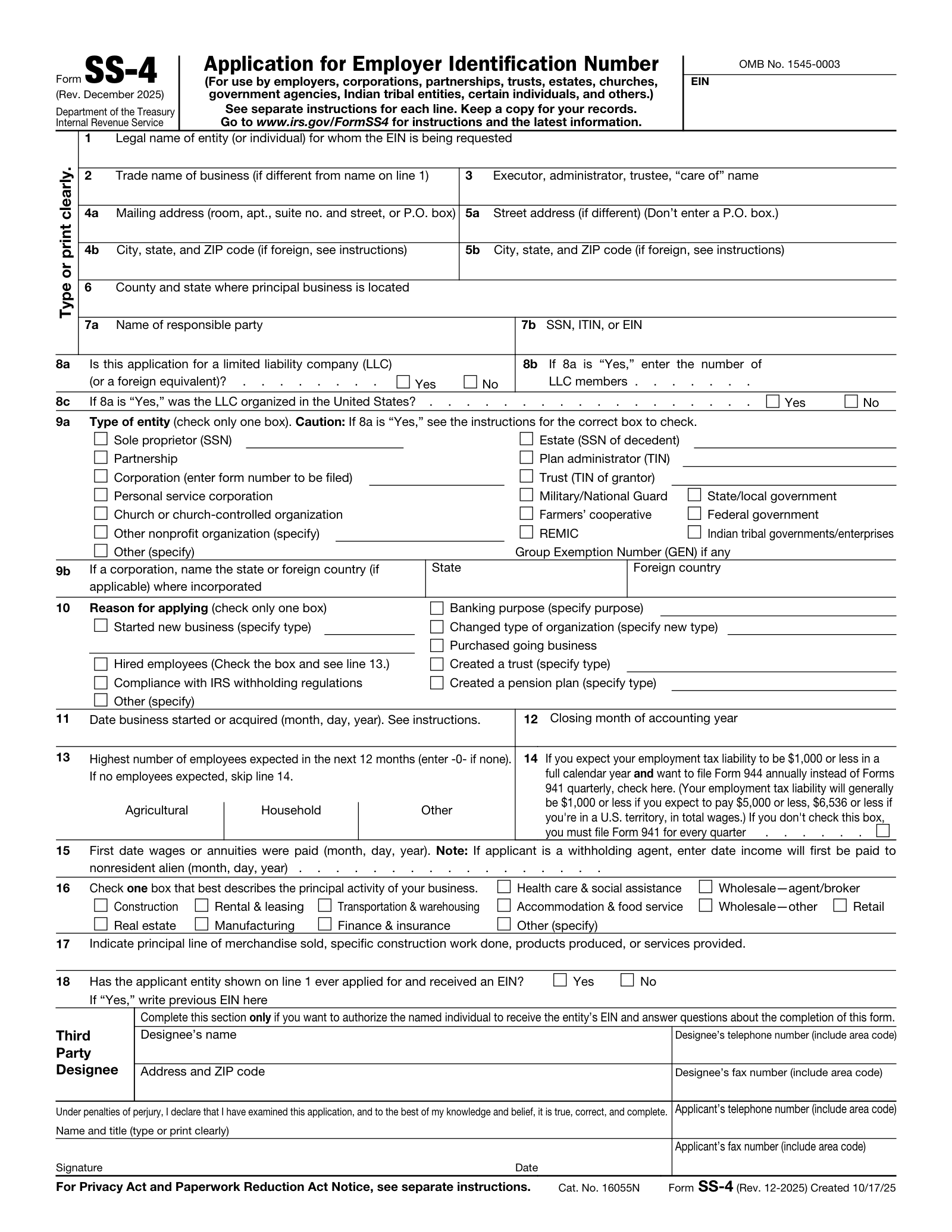
Official form (IRS.gov): Form SS-4 official PDF
EIN steps:
- Complete Form SS-4. Legal name exactly as on your formation documents.
- Name the responsible party and use your foreign address.
- Fax it to the IRS number for international applicants, or mail it. Confirm the current fax number on the IRS site before you send:
- Wait for the notice with your EIN. Processing time for fax and mail applications:
- No fee. The government charges $0.
- Complete Form W-7.
- Attach a certified copy of your passport, or apply through a Certifying Acceptance Agent who can verify your documents.
- Mail to the IRS address on the form.
- No fee. Processing takes weeks to months:
ITIN steps:
Your entity needs a US address for state purposes, which is what a registered agent (a service that receives legal mail on your behalf) provides. The EIN application itself does not require a US address, and you should not borrow someone else's.
Tip: keep the IRS notice with your EIN (CP 575) or request a 147C letter later. Banks and processors ask for it more often than you expect.
What a tax ID does not obligate you to
An EIN or ITIN is an identification number. It is not a tax residency trigger, a citizenship path, or a green card. Holding one creates no US trade or business, no permanent establishment, and no sales tax nexus.
Filing obligations flow from three things: your entity type, your activity, and where your income comes from. Not from the number in the box.
- An ITIN does not authorize you to work in the US and does not change your immigration status [2].
- An EIN does not make you a US tax resident. Residency turns on days present and facts, not on paperwork.
- A foreign-owned disregarded LLC with an EIN still has the Form 5472 and pro forma 1120 obligation. That is the trap: no personal tax, real filings.
Suppose a founder reads that an EIN means the IRS now expects a personal return. That is wrong, and acting on it wastes money on returns that are not due. The reverse error costs more: skipping Form 5472 because "the LLC made no US income" and meeting a $25,000 penalty.
If you want the filing side handled properly, federal tax support for Form 5472 and Form 1120 is where to look.
Where to apply and what to expect
EIN goes on Form SS-4 by fax or mail. ITIN goes on Form W-7 by mail or through a Certifying Acceptance Agent. SSN goes on Form SS-5, and only if you are work-authorized.
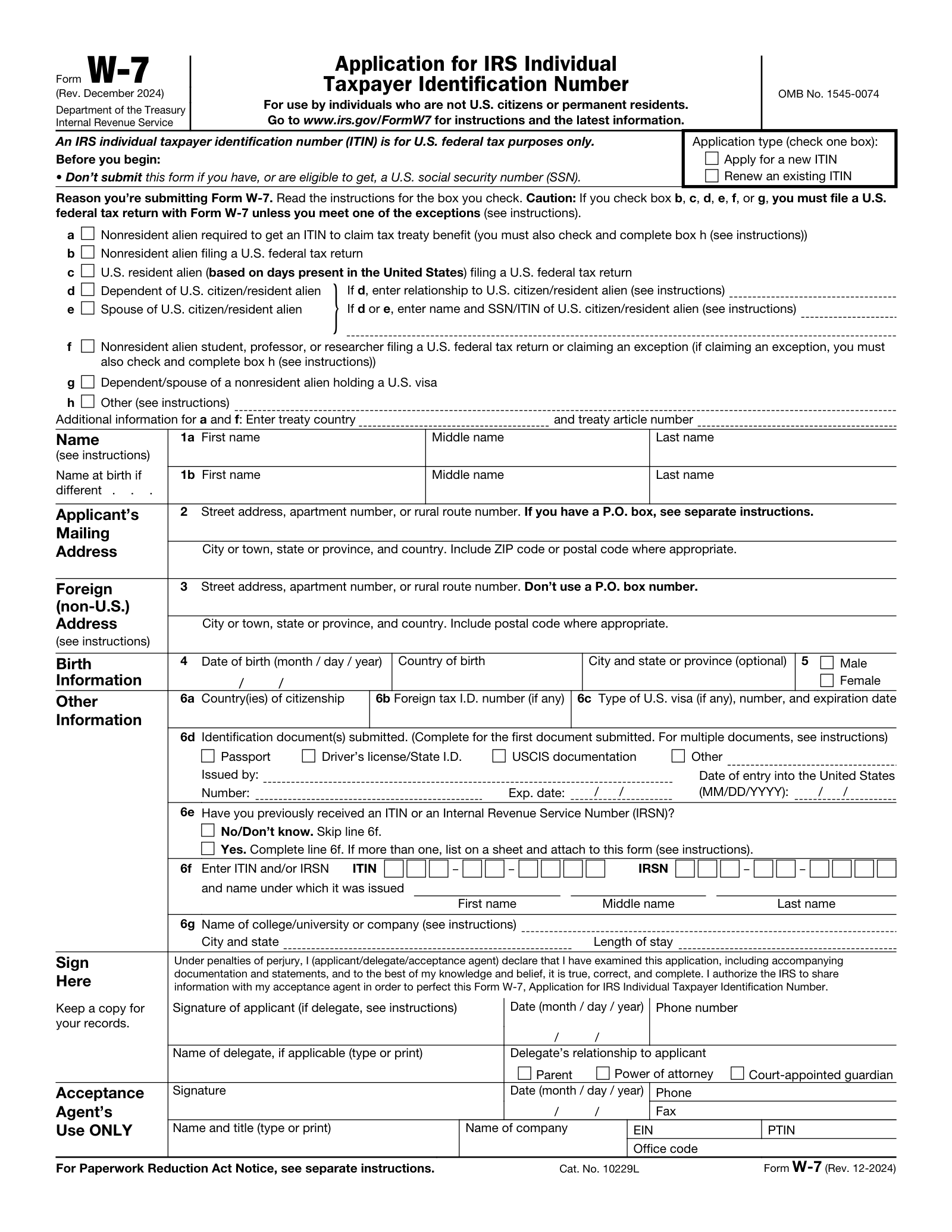
Official form (IRS.gov): Form W-7 official PDF
| Form | Purpose | Where to file | Government fee | Processing time |
|---|---|---|---|---|
| SS-4 | EIN application | IRS, fax or mail | $0 | Check the current IRS processing time |
| W-7 | ITIN application | IRS, mail or via CAA | $0 | Check the current IRS processing time |
| SS-5 | SSN application | Social Security Administration | $0 | Varies |
What you need in hand before you start: legal name exactly as filed with the state, responsible party details, your foreign address, entity type, and for the W-7, certified identification.
Common rejection reasons: a name mismatch between the SS-4 and the state formation documents, a missing signature, the wrong entity type box, and for the W-7, uncertified documents. Fix the name before you file, not after.
Keeping your tax ID records consistent across banks and platforms
Use the exact legal name and EIN shown on IRS records on every bank, processor, and platform profile. Mismatches cause onboarding delays and, worse, backup withholding.
Which form goes where:
- W-9: US persons and US entities. If you are a non-resident, this is not your form.
- W-8BEN: foreign individuals, including freelancers providing services.
- W-8BEN-E: foreign entities, including your US LLC when it is treated as foreign for these purposes.
Banks and processors like Stripe and Mercury check the EIN against IRS records. Keep the CP 575 or 147C letter ready. And note that W-8BEN and W-8BEN-E also ask for a foreign TIN, your home-country tax number, which is separate from the US EIN or ITIN [8].
Say your Stripe account is under "Acme Labs Pvt Ltd" but the IRS knows your LLC as "Acme Labs LLC." Onboarding stalls, support tickets pile up, and payouts freeze until the names match. Five minutes of checking saves two weeks.
If you are choosing where to bank, opening a US business bank account as a non-resident covers the online and fintech route.
Common mistakes non-residents make with US tax IDs
Most of these cost money or time. None of them are exotic.
- Assuming you need an ITIN to get an EIN. You do not. Line 7b of Form SS-4 handles it.
- Applying for an ITIN with no filing requirement. The IRS issues ITINs against a filing need or exception, so a bare application gets rejected [2].
- Borrowing a US address or someone's SSN on Form SS-4. Never do this. It creates a mismatch the IRS will find.
- Believing an EIN makes you a US tax resident. It does not, and it opens no work-authorization path.
- Skipping Form 5472 and the pro forma 1120. The $25,000 penalty applies even with zero US income.
- Letting names drift. EIN record, state formation documents, bank account, and Stripe profile should all read identically.
- Paying a "tax ID service" without knowing the government fee. Form SS-4 and Form W-7 cost $0. Agent and CAA fees are separate provider costs and vary.
Do the SS-4 yourself if you are comfortable with forms. Skip paid expediting services that promise speed the IRS does not offer.
Frequently Asked Questions
Can I get an EIN without an SSN or ITIN? Yes. Form SS-4 line 7b allows "Foreign" when the responsible party has no US tax ID. Non-residents apply by fax or mail.
Does getting an EIN make me a US tax resident? No. An EIN is an identification number. Tax residency depends on days present and your facts.
Do I need an ITIN if I already have an EIN for my LLC? Usually not for the LLC. An ITIN matters only if you personally have a US filing requirement or exception, such as a treaty claim.
How much does a US tax ID cost? The government fee is $0 for Form SS-4 and Form W-7. Third-party agent or CAA fees are separate and vary.
What form do I give a US client as a non-resident? Form W-8BEN as an individual, or W-8BEN-E as an entity. W-9 is for US persons.
Can I use my EIN to open a US bank account remotely? Some fintechs and banks allow remote onboarding for foreign-owned entities. Policies vary, and the EIN plus formation documents are typically required.
Start with the entity. Get the EIN, keep the legal name identical everywhere, and only then decide whether you personally need an ITIN. For the personal side, applying for an ITIN with Form W-7 is the next step if a filing requirement appears. NexFyla helps non-US founders form US companies and set up EIN and US business banking support. If you want help with US LLC formation, EIN and business setup, NexFyla can assist.
*Last updated: February 2026.*